Saturday, February 20, 2010

Friday, February 19, 2010


NYPD watchdog agency could soon try own cases
NYPD watchdog agency could soon try own cases
Associated Press - February 18, 2010 8:35 PM ET
NEW YORK (AP) - Attorneys for New York City's police watchdog agency could soon begin prosecuting cases stemming from complaints it receives and investigates.
Police Commissioner Raymond Kelly and Civilian Complaint Review Board Chair Ernest F. Hart announced an agreement Thursday to launch a pilot project to allow some CCRB cases to be tried by the independent agency's own attorneys.
The move would hand some of the NYPD's control over how it handles allegations of officer misconduct to an agency that has historically been considered ineffectual.
All of 2009's 130 administrative trials against police officers were prosecuted by NYPD attorneys.
Twenty of those cases originated as CCRB complaints. The agency's attorneys sometimes served as co-counsel.
The board received more than 7,600 complaints in 2009.
NYPD watchdog agency could soon try own cases - WCAX.COM Local Vermont News, Weather and Sports-.
City’s Affordable Housing Program Faces Trouble Finding Buyers
 clipped from www.nytimes.com clipped from www.nytimes.com
|
UPTOWN ACTIVITIES
MORRIS-JUMEL MANSION Saturday, 1 to 4 p.m., “Colonial Chocolate Day,” with a lecture about social drinking in the 18th and 19th centuries and a demonstration of chocolate-making. Museum hours: Wednesdays through Sundays, 10 a.m. to 4 p.m.; 65 Jumel Terrace, at 161st Street, east of St. Nicholas Avenue, Harlem , (212) 923-8008, morrisjumel.org; $20, $15 for members, $10 for children 7 to 16.
SCHOMBURG CENTER FOR RESEARCH IN BLACK CULTURE Saturday at 3 p.m., two documentary films on carnival celebrations in Trinidad and Brazil. Through April 18, two exhibitions in celebration of the first anniversary of Barack Obama’s presidency: one is “Jerry Pinkney’s African-American Journey to Freedom,” a collection of 35 watercolor paintings that portray black history. The second exhibition, “President Barack Obama: The First Year,” is a display of more than 70 photographs by Pete Souza, the official White House photographer. Thursday and Friday, 11 a.m. to 6 p.m.; Saturday, 10 a.m. to 5 p.m.; Monday through Wednesday, noon to 8 p.m. 515 Malcolm X Boulevard, at 135th Street, Hamilton Heights , (212) 491-2200, nypl.org; free.
HARLEM FINE ARTS SHOW Saturday, 11 a.m. to 10 p.m., and Sunday, 11 a.m. to 7 p.m., with paintings, drawings, and illustrations by more than 60 black American artists. 369th Regiment Armory, 2366 Fifth Avenue, between 142nd and 143rd Streets, Harlem , (866) 388-4849, harlemfineartsshow.com; $20; $10 for children 12 and younger.
‘LATINOS IN THE U.S.: ¡PRESENTE!’ Through June 10, an exhibition on the history, growth and diversity of Latino communities, told with photographs, clothing and other items. Fridays, 8 a.m. to 9 p.m.; Saturdays, 9 a.m. to 6 p.m.; Sundays, noon to 6 p.m.; Mondays through Thursdays, 8 a.m. to 11 p.m.; City College of New York, Cohen Library, Convent Avenue and 138th Street, Harlem , (212) 650-7271, www1.cuny.edu; free.
NEW YORK ROAD RUNNERS Saturday at 9 a.m., “Run for Haiti,” a four-mile run/walk in Central Park, beginning on the East Drive, near 68th Street; kids’ races begin at 10:30 a.m. Registration is Friday, 1 to 7 p.m., and Saturday, 7:30 to 8:30 a.m., at New York Road Runners, 9 East 89th Street, Manhattan; $40, free for kids’ races. Thursday Night at the Races continues, from 7 to 10 p.m., at the New Balance Track and Field Center at the Armory, 216 Fort Washington Avenue, at 168th Street, Washington Heights; $15, cash only. (212) 860-4455, nyrr.org.
Queen Afua Wellness Institute
| |||||||||||||
 Greetings,
Thursday, February 18, 2010
Why Do Black People Love Fried Chicken?
EUR Book Look: Why Do Black People Love Fried Chicken?
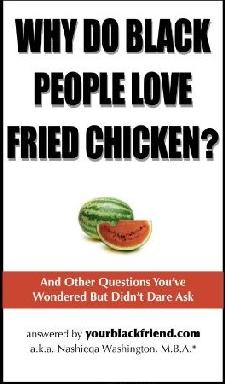
As a non-angry black woman, I’ve been able to compile these questions because of the level of comfort people felt approaching me and asking them… The questioners have ranged from those who have little or no contact with blacks to those in intimate relationships (some marital) with a black person.
I have received questions so regularly that I am convinced that the publication of answers provides a much-needed service. So with the hope of improving relations and in order to spare other black folks, within these pages you will fid the answers to many of your questions.” — Excerpted from the Message to the Reader (pages 1-2)
*Over the years, many an unscrupulous author has assumed an alibi in order to pass as a member of another ethnic group. Perhaps the most infamous of these so-called “slippery characters” was Ku Klux Klansman Asa Carter who faked a Native American background to publish “The Education of Little Tree,” a critically-acclaimed memoir about growing up Cherokee which not only topped the NY Times Bestseller List back in the Seventies but won the Book of the Year Award as well.
Truth be told, Carter was an inveterate segregationist and white supremacist who attacked Nat King Cole when he came to Alabama to perform in 1956, and who castrated a black janitor a year later, before being hired by Alabama Governor George Wallace as his speechwriter. So excuse me for being a little skeptical about Why Do Black People Love Fried Chicken, and wondering whether the person posing as the suspicious-sounding Nashieqa Washington was an opportunist or actually African-American.

Nashieqa Washington
As it turns out, Nashieqa is, in fact, a sister, although her real name is Pam Moore. Furthermore, the asterisked MBA after her name on the cover came not from her earning a business degree but rather from her being a “Member of Black America.” She does, however, have a BA in Political Science from Cal State, which I guess is more than enough to set yourself up as an expert on black folks nowadays.
Basically, her book is designed to address 66 of the most common questions that curious white people have repeatedly asked her about African-Americans, ranging from “What is CPT?” (The true black ETA at an affair) to “Why don’t black people get wrinkles?” (Because black don’t crack) to “Do blacks deserve reparations? (Yes, past due wages, plus interest) to “Can black people be racist?” (No.).
Nashieqa doesn’t presume to speak for all black people, instead stipulating that her conclusions were arrived at based upon anecdotal evidence and her own personal observations, not anything scientific. Thus, her responses are intended to entertain as much as they elucidate. Sometimes, she even admits to being stumped, like by the query, “Why do black people talk to the movie screen?”
Some of the answers will inflame African-American readers (See: “Why are blacks so lazy?”) while others are just as apt to annoy whites, (See: “Is everything related to slavery?”) especially since the author is earnest in her endeavor to generate frank conversation across the color line’s cross-cultural divide.
Overall, I found the book to be both fun and thought-provoking, if not at all dispositive or the last word on any particular topic. Ultimately, it probably proved more revealing of the author’s mindset than of any monolithic African-American cultural traits. For who would bother to give such serious as opposed to tongue-in-cheek answers to questions reflecting underlying racist assumptions such as “Why are blacks so paranoid?” “Why do black people speak improper English?” and “Why are black women always angry?”
Nashieqa Washington would that’s who. I say now it’s Pam Moore’s turn to emerge from the shadow of her alter ego and make herself vulnerable by writing an intimate autobiography tackling similar subject-matter. For it’s easy to read between the lines, here, to sense that Ms. Moore has played her cards close to the vest and might be ready to share a brutally-honest tell-all about what it really feels like to be a black woman in America.
To order a copy of Why Do Black People Love Chicken, visit: http://www.amazon.com/gp/product/0977792102?ie=UTF8&tag=thslfofire-20&linkCode=as2&camp=1789&creative=390957&creativeASIN=0977792102
Why Do Black People Love Fried Chicken?
And Other Questions You’ve Wondered but Didn’t Dare Ask
by Nashieqa Washington, MBA
MoreMindful Publishing
Paperback, $13.95
100 pages
ISBN: 978-0-9777921-0-2
Article printed from EURweb: http://www.eurweb.com
URL to article: http://www.eurweb.com/?p=8056
Have a Tattoo or Walk With a Limp? The Police May Know
 clipped from www.nytimes.com clipped from www.nytimes.com
The tattoo database is one of dozens kept by the Police Department in its technological information hub, the Real Time Crime Center, |

THEATER REVIEW | 'BLACK ANGELS OVER TUSKEGEE'
 clipped from www.nytimes.com clipped from www.nytimes.com
The leisurely 2-hour-20-minute play is full of good intentions, decent talent and not an ounce of daring. Mr. Gray, who stages his own work, steers his underdog story so cautiously, moving in the straightest of lines, that you don’t always realize how deftly he’s setting you up. |

Understanding Health Disparities among New York City's Five Counties
| Health E-News |
February 17, 2010 |
 | ||
| ||||
| ||||
 In a report issued today, the Robert Wood Johnson Foundation ranks counties on various measures of health. As expected, the findings show significant health disparities among counties in most states, including New York. Whether counties are ranked by "health outcomes" (rates of illness and death) or by "health factors" (characteristics that influence health), counties with large minority populations and high rates of poverty consistently rank as less healthy. Among New York City's five counties (boroughs), Manhattan, Queens and Staten Island rank relatively high among the 62 counties in New York State. Brooklyn and the Bronx rank at or near the bottom.
 Wednesday, February 17, 2010
Gil Scott-Heron Album Release Party and Tribute


45 West 53rd Street (between Fifth & Sixth Avenues)
Official Site | RSVP link
Time: 5:30pm
Cost: Free
Gil Scott-Heron Album Release Party and Tribute
Join the Folk Art Museum for an evening in tribute to the legendary musician and poet Gil Scott-Heron. “At this special Free Music Friday you will hear Gil Scott-Heron’s brand new album entitled “I’m New Here,” enjoy a screening
of a GSH music video and documentary, and have the opportunity to purchase the new CD at a discount. In connection with Black History Month, the museum will also provide exhibition tours highlighting artworks created by African American artists. Refreshments will be served.” Ends at 7:30pm.
NYPD: Stop And Frisks Up Eight Percent In '09 - NY1.com
NYPD: Stop And Frisks Up Eight Percent In '09
By: NY1 News
To view our videos, you need to
enable JavaScript. Learn how.
install Adobe Flash 9 or above. Install now.
Then come back here and refresh the page.
Stop and frisks by the New York City Police Department are at an all time high, police data shows.
According to the report, city officers stopped more than 575,000 people in 2009 -- an eight percent jump from the year before.
The latest batch of numbers shows the majority of those stopped were black and Hispanic men.
According to the report, only six percent of the stops ended in arrests.
The practice has been criticized by civil rights advocates as being "disproportionate and discriminatory."
The NYPD says stop and frisks are a valuable law enforcement tool.
Feds won't pursue NYPD shooting of man in 2006
Feds won't pursue NYPD shooting of man in 2006
Three New York police officers who killed an unarmed man in a 50-shot barrage outside a seedy strip club hours before his wedding will not face civil rights charges, federal authorities said Tuesday.
The parents and former fiancee of Sean Bell, along with the Rev. Al Sharpton, had lobbied federal prosecutors in Brooklyn to charge the officers with violating Bell's civil rights.
"After a careful and thorough review, a team of experienced federal prosecutors and FBI agents determined that the evidence was insufficient to prove, beyond a reasonable doubt, that the law enforcement personnel who fired at Bell (and two friends, Joseph Guzman and Trent Benefield) acted willfully," the Justice Department said in statement. "Accordingly, the investigation into this incident has been closed."
U.S. Attorney Benton Campbell met with Bell's family members Tuesday to tell them. At a news conference at Sharpton's headquarters in Harlem later Tuesday, Guzman, Benefield and Bell's fiance, Nicole Paultre Bell, said they were disappointed but would continue to demand that the officers be fired and the city held accountable through a pending wrongful death lawsuit.
"It's not the first time I've been let down," Paultre Bell said. "It's happening all over again."
Asked about insufficient evidence, Guzman responded, "Fifty shots on a New York City street. I seen it. I was there."
An attorney for one of the New York Police Department officers called it "the right decision."
Accusing the officers of federal crimes after a state court acquittal "would have been a real stretch," said the lawyer, James Culleton. "Everyone should move on."
Bell, a 23-year-old black man, was killed and his friends were seriously injured outside Kalua Cabaret in Queens in 2006 as they were leaving his bachelor party by car. The officers, all undercover detectives, had been investigating reports of prostitution at the club.
No weapon was found in Bell's blood-splattered, bullet-riddled car.
The shooting sparked community outrage and accusations that the New York Police Department was too quick to use excessive force against minorities.
At a non-jury trial in 2008, prosecutors portrayed the officers as trigger-happy cowboys. They accused one of the shooters, undercover detective Michael Oliver, of firing 31 of the 50 total shots — even pausing to reload.
An undercover working with the accused officers testified that they became alarmed after witnessing a heated argument outside the club between Bell's friends and another patron who appeared to have a gun. He claimed they overheard Guzman, say, "Yo, go get my gun."
In grand jury testimony, Detective Gescard Isnora said that he decided to follow Bell, Guzman and Benefield to their car because he believed they were going to commit a drive-by shooting.
Guzman denied saying anything about a gun; other witnesses also testified that the dispute ended peacefully. He and Benefield also testified that they never heard the officers yell warnings before opening fire and tried to drive away because they feared for their lives.
Isnora gave a different account: When he confronted the men, he only resorted to deadly force after Bell bumped him with the car and smashed into an unmarked police van, and after he spotted Guzman make a sudden move as though he were going for a gun.
A judge ended up acquitting the three shooters of state charges that included manslaughter, assault and reckless endangerment. The Justice Department said afterward it would review the incident, though a civil rights case was always considered a long shot.
Police Commissioner Raymond Kelly said Tuesday that the decision clears the way for the NYPD to pursue disciplinary charges against the three detectives and one other shooter who wasn't charged in the criminal case. He declined to comment further.
___
Associated Press writer Adam Goldman contributed to this report.
(Ads will not print)
Lucille Clifton, Poet Who Explored Intricacies of Black Lives, Dies at 73
 clipped from www.nytimes.com clipped from www.nytimes.com
Ms. Clifton received a National Book Award in 2000 for “Blessing the Boats: New and Selected Poems, 1988-2000,” published by BOA Editions.
|

